East Point College of Engineering and Technology — Fees, Courses & Admission
East Point College of Engineering and Technology is a private college in Bengaluru, Karnataka. East Point College of Engineering and Technology is privately managed and self-financing. East Point…
NBA 3 progs · Tier IIAICTE 1-6231206
₹5 lakh/year
Median salary · placed four-year UG graduates · 2024-25 · Source
902
Total intake
Overview
About EPCET
East Point College of Engineering and Technology is a private college in Bengaluru, Karnataka. East Point College of Engineering and Technology is privately managed and self-financing. East Point College of Engineering and Technology offers 9 programmes, 7 at undergraduate level and 2 at postgraduate level. These include B.E. Computer Science and Engineering, B.E. Electronics and Communication Engineering, B.E. Information Science and Engineering, B.E. Computer Science and Engineering (Artificial Intelligence and Machine Learning) and B.E. Computer Science and Engineering (Data Science), among others. EPCET is a 15.9-acre engineering campus within the larger 99-acre East Point group campus, with 55 ICT-enabled classrooms, 4 seminar halls, a KOHA-enabled library, sports infrastructure, gym, cafeteria, and department laboratories. EPCET publishes boys and girls hostels on campus; the latest mandatory disclosure lists 566 seats. EPCET has six VTU-approved research centres, 22 listed supervisors, 41 current research scholars in the RD Cell evidence, patent output, and a broad industry/academic MoU network. The campus extends over about 16 acres.
Seat categories as published in the cited official source.
Branch
Annual fee
B.E. branches
Management seats (Category-3: management, NRI and other) · 2026–27
KEA’s 2026–27 engineering seat matrix lists EPCET among private unaided engineering colleges and divides each B.E. course’s intake into Category-1 government (KEA) seats, Category-2 COMEDK seats and Category-3 management, NRI and other seats. The seat matrix allocates seats and does not list fees. Ask the college for the written 2026–27 fee for your branch and seat category, and its payment schedule, before paying.
Route comparison · KCET vs COMEDK vs management quota
KCET / KEALowest government-quota fee when the student has a qualifying Karnataka counselling rank.
COMEDKMerit counselling route for private engineering colleges, usually higher than KCET and lower than management quota.
Management quota / direct admissionBranch-specific fee and seat status must be verified before payment; use official receipts and institution payment channels.
2Submit application form + Class 12 marksheet + KCET or COMEDK rank card. If an NRI or sponsored route is applicable, sponsor documents may be required.
3Verify branch availability, official receipt format and refund policy before payment. Payment should go to the institution account.
4Pay only institution-confirmed tuition plus any documented college-level charges through the official payment channel. Hostel + transport billed separately; original documents deposited at admission.
Get current 2025-26 tier rates and branch-wise availability checks via WhatsApp.CollegeAndFees counsellor: +919844736561
Authority annual tuition-plus-other fee; applicable university and approved college-level charges are separate. Admission-route charges are distinct from management fees.
Authority annual tuition-plus-other fee; applicable university and approved college-level charges are separate. Admission-route charges are distinct from management fees.
Authority annual tuition-plus-other fee; applicable university and approved college-level charges are separate. Admission-route charges are distinct from management fees.
Authority annual tuition-plus-other fee; applicable university and approved college-level charges are separate. Admission-route charges are distinct from management fees.
Programme
Academic year / route / code
Annual tuition (INR)
Annual other fee (INR)
Authority annual total (INR)
B.E. Computer Science and Engineering (Artificial Intelligence and Machine Learning)
Authority annual tuition-plus-other fee; applicable university and approved college-level charges are separate. Admission-route charges are distinct from management fees.
Programme
Academic year / route / code
Annual tuition (INR)
Annual other fee (INR)
Authority annual total (INR)
B.E. Computer Science and Engineering (Data Science)
Authority annual tuition-plus-other fee; applicable university and approved college-level charges are separate. Admission-route charges are distinct from management fees.
Programme
Academic year / route / code
Annual tuition (INR)
Annual other fee (INR)
Authority annual total (INR)
B.E. Computer Science and Engineering (Internet of Things and Cyber Security including Block Chain Technology)
Fees for government (KCET) seats. KEA publishes separate Type-1 and Type-2 amounts for private unaided colleges, including minority colleges; the row that applies depends on the college’s fee type and the candidate’s category. KEA’s amounts include the university fee (₹12,320) and other fees (₹20,000).
Fee schedule
Academic year
Candidate category
Amount (INR)
EPCET mandatory disclosure: approved tuition fee, CET seats in seven listed B.E. programmes (other fees: nil)
2025–26
CET seat
1,21,610
KEA: Type-1 private unaided colleges
2026–27
General merit (GM, 2A, 2B, 3A, 3B; SC/ST with family income above ₹10 lakh; Category-1 above ₹2.5 lakh)
1,20,320
KEA: Type-1 private unaided colleges
2026–27
Category-1, family income up to ₹2.5 lakh
96,170
KEA: Type-1 private unaided colleges
2026–27
SNQ (supernumerary quota)
32,320
KEA: Type-2 private unaided colleges
2026–27
General merit (GM, 2A, 2B, 3A, 3B; SC/ST with family income above ₹10 lakh; Category-1 above ₹2.5 lakh)
Management seats (Category-3: management, NRI and other) · 2026–27
KEA’s 2026–27 engineering seat matrix lists EPCET among private unaided engineering colleges and divides each B.E. course’s intake into Category-1 government (KEA) seats, Category-2 COMEDK seats and Category-3 management, NRI and other seats. The seat matrix allocates seats and does not list fees. Ask the college for the written 2026–27 fee for your branch and seat category, and its payment schedule, before paying.
EPCET’s NIRF 2026 Engineering submission reports 111 students placed among 373 minimum-time four-year UG graduates in 2024–25, with a ₹5 lakh median annual salary among placed graduates and 15 higher-study selections reported separately.
Updated
College-wide UG placement outcomes (NIRF 2026)
These are institution-submitted NIRF figures for the whole college, reported by graduating cohort rather than by branch. The percentage is calculated here as students placed divided by students graduating in minimum stipulated time. It is not the percentage of the admission intake, placement registrants or recruiter-eligible students. Higher-study selections remain a separate count. Median annual salary describes the reported placed graduates; it is neither an average nor a highest package, and it is not monthly take-home pay.
On smaller screens, scroll the table sideways to see every column.
The UG NIRF median is ₹7 lakh for 2023–24 and ₹5 lakh for 2024–25. These are annual medians among placed graduates, not branch averages or highest offers. Use the year and statistic attached to each source when comparing salary outcomes.
The Engineering NIRF PG two-year table reports 14 placed from 18 timely graduates in 2022–23, none of 13 timely graduates in 2023–24 and none of 5 in 2024–25.
The placement website describes East Point Group services, includes pharmacy alumni and pool/off-campus support, and refers to 200+ clients. These are not counts of EPCET engineering recruiters or hires in a specified year.
The published EPGI policy requires placement registration, company-specific opt-in and participation in training. Recruiter eligibility is final and the cell may impose additional conditions; backlogs can disqualify applicants at many companies.
The policy permits a student already holding an offer to compete for a role with CTC at least ₹2 lakh per annum higher, and stops further campus participation once two offers are secured. This is a concrete reason that offer totals need not equal unique placed students. Pool-campus events may require travel to another college.
For interviews, the policy asks for at least five resume copies, copies of certificates, five photographs and government/college ID. It says pre-placement talks should explain salary breakdown, role, location, bonds and joining date; these details are important when comparing offers.
Placement contact and programme-specific questions
The placement page names Prof. Dhananjay Kumar as Director–Training and Placement. Use the published campus contact +91 72042 29999 / info@eastpoint.ac.in to request the engineering placement office and a written EPCET-specific report.
For the exact engineering branch and completed graduation year, request unique placed students, offers, joined jobs, campus/pool/off-campus classification, higher studies and salary medians. Use a matching denominator for any percentage; a mission-statement placement goal describes an objective rather than an achieved outcome.
For tuition and management-quota information, return to the EPCET college overview. Confirm current costs with the institution.
Campus
EPCET gallery
7 photos
Tap any photo to view it full screen. Source images retain the institution and campus identified in their captions.
Programmes · intake
Programmes & intake
B.E. Computer Science and Engineering
CSE4 yrKEA · E096COMEDK · E046NBA
300intake
Institutional CET fee entry in the disclosure dated 9 August 2025; this table labels the published amount as a fee rather than tuition alone. Authority annual tuition-plus-other fee; applicable university and approved college-level charges are separate. Admission-route charges are distinct from management fees.
Programme / schedule / route
Published field
Value
B.E. Computer Science and Engineering | 2025–26 CET
Published fee entry (INR)
₹121,610
B.E. Computer Science and Engineering | 2025–26 COMEDK E046
Annual tuition (INR)
₹200,000
B.E. Computer Science and Engineering | 2025–26 COMEDK E046
Annual other fee (INR)
₹20,000
B.E. Computer Science and Engineering | 2025–26 COMEDK E046
Institutional CET fee entry in the disclosure dated 9 August 2025; this table labels the published amount as a fee rather than tuition alone. Authority annual tuition-plus-other fee; applicable university and approved college-level charges are separate. Admission-route charges are distinct from management fees.
Programme / schedule / route
Published field
Value
B.E. Electronics and Communication Engineering | 2025–26 CET
Published fee entry (INR)
₹121,610
B.E. Electronics and Communication Engineering | 2025–26 COMEDK E046
Annual tuition (INR)
₹200,000
B.E. Electronics and Communication Engineering | 2025–26 COMEDK E046
Annual other fee (INR)
₹20,000
B.E. Electronics and Communication Engineering | 2025–26 COMEDK E046
Institutional CET fee entry in the disclosure dated 9 August 2025; this table labels the published amount as a fee rather than tuition alone. Authority annual tuition-plus-other fee; applicable university and approved college-level charges are separate. Admission-route charges are distinct from management fees.
Programme / schedule / route
Published field
Value
B.E. Information Science and Engineering | 2025–26 CET
Published fee entry (INR)
₹121,610
B.E. Information Science and Engineering | 2025–26 COMEDK E046
Annual tuition (INR)
₹200,000
B.E. Information Science and Engineering | 2025–26 COMEDK E046
Annual other fee (INR)
₹20,000
B.E. Information Science and Engineering | 2025–26 COMEDK E046
B.E. Computer Science and Engineering (Artificial Intelligence and Machine Learning)
CSE — AIML4 yrKEA · E096COMEDK · E046
120intake
Institutional CET fee entry in the disclosure dated 9 August 2025; this table labels the published amount as a fee rather than tuition alone. Authority annual tuition-plus-other fee; applicable university and approved college-level charges are separate. Admission-route charges are distinct from management fees.
Programme / schedule / route
Published field
Value
B.E. Computer Science and Engineering (Artificial Intelligence and Machine Learning) | 2025–26 CET
Published fee entry (INR)
₹121,610
B.E. Computer Science and Engineering (Artificial Intelligence and Machine Learning) | 2025–26 COMEDK E046
Annual tuition (INR)
₹200,000
B.E. Computer Science and Engineering (Artificial Intelligence and Machine Learning) | 2025–26 COMEDK E046
Annual other fee (INR)
₹20,000
B.E. Computer Science and Engineering (Artificial Intelligence and Machine Learning) | 2025–26 COMEDK E046
B.E. Computer Science and Engineering (Data Science)
CSE — DS4 yrKEA · E096COMEDK · E046
60intake
Institutional CET fee entry in the disclosure dated 9 August 2025; this table labels the published amount as a fee rather than tuition alone. Authority annual tuition-plus-other fee; applicable university and approved college-level charges are separate. Admission-route charges are distinct from management fees.
Programme / schedule / route
Published field
Value
B.E. Computer Science and Engineering (Data Science) | 2025–26 CET
Published fee entry (INR)
₹121,610
B.E. Computer Science and Engineering (Data Science) | 2025–26 COMEDK E046
Annual tuition (INR)
₹200,000
B.E. Computer Science and Engineering (Data Science) | 2025–26 COMEDK E046
Annual other fee (INR)
₹20,000
B.E. Computer Science and Engineering (Data Science) | 2025–26 COMEDK E046
B.E. Computer Science and Engineering (Internet of Things and Cyber Security including Block Chain Technology)
CSE — IoT-CS-BCT4 yrKEA · E096COMEDK · E046
60intake
Institutional CET fee entry in the disclosure dated 9 August 2025; this table labels the published amount as a fee rather than tuition alone. Authority annual tuition-plus-other fee; applicable university and approved college-level charges are separate. Admission-route charges are distinct from management fees.
Programme / schedule / route
Published field
Value
B.E. Computer Science and Engineering (Internet of Things and Cyber Security including Block Chain Technology) | 2025–26 CET
Published fee entry (INR)
₹121,610
B.E. Computer Science and Engineering (Internet of Things and Cyber Security including Block Chain Technology) | 2025–26 COMEDK E046
Annual tuition (INR)
₹200,000
B.E. Computer Science and Engineering (Internet of Things and Cyber Security including Block Chain Technology) | 2025–26 COMEDK E046
Annual other fee (INR)
₹20,000
B.E. Computer Science and Engineering (Internet of Things and Cyber Security including Block Chain Technology) | 2025–26 COMEDK E046
EPCET is the Bidarahalli engineering college within East Point Group. Its 2026–27 approval is available, but applicants need clarification of the college’s higher published marks threshold and any Mechanical Engineering intake before accepting an offer.
Updated
Campus, identity and current approved intake
EPCET’s AICTE 2026–27 EoA identifies the engineering institution at Jnana Prabha, Bidarahalli, Virgonagar Post, Bengaluru 560049, permanent ID 1-6231206. It is distinct from the other East Point Group colleges. The admission help desk also uses Avalahalli as a locality label.
The EoA lists the seven undergraduate programmes below, totalling 870 regular seats, plus 16 each in M.Tech Product Design and Manufacturing and Construction Technology. These are sanctioned intakes, not currently vacant seats.
On smaller screens, scroll the table sideways to see every column.
EPCET’s undergraduate web page lists Mechanical Engineering with 30 seats. The AICTE extension of approval for 2026–27, approved on 16 March 2026, lists seven first-year B.E. programmes: Civil Engineering (30), Computer Science and Engineering (300), CSE (Artificial Intelligence and Machine Learning) (120), CSE (Data Science) (60), CSE (IoT and Cyber Security including Blockchain Technology) (60), Electronics and Communication Engineering (180) and Information Science and Engineering (120). COMEDK’s 2026–27 seat and fee matrix lists EPCET (E046) seats in seven courses, none of them Mechanical Engineering. Before applying for a first-year Mechanical seat, ask the admissions desk which route offers it for 2026–27.
For a counselling seat, complete the relevant KEA/KCET or COMEDK process and match the college, campus and branch in the allotment. For institutional admission, use the official East Point admissions desk and ask for the approved route and deadline. The EoA marks NRI approval No and international-student approval Yes for the listed UG courses; these are distinct regulatory fields, not interchangeable quotas.
EPCET’s official brochure prints CET E096 and COMEDK E046, not the same code for both systems. This is historical brochure evidence, not a live seat matrix; match the institution name and branch in the applicable current counselling system.
EPCET’s undergraduate page currently says at least 50% for general candidates and 45% for Karnataka SC/ST/CAT-1 candidates. KEA’s 2026 engineering bulletin instead specifies 45% and the applicable 40% Karnataka reserved-category concession; COMEDK’s 2026 guide also specifies 45%/40% under its category rules.
A general applicant with 45%–49.99%, or an eligible Karnataka reserved-category applicant with 40%–44.99%, should get written confirmation of the applicable threshold from the counselling authority and from EPCET before applying.
For COMEDK 2026, pass 12th/2nd PUC or equivalent with English as a language, Physics and Mathematics compulsory, and Chemistry, Biotechnology, Biology, Electronics or Computer Science as the third qualifying subject. The required aggregate is 45%; the 40% concession is for SC, ST and OBC candidates of Karnataka, not every reserved-category applicant from another state. The specified subjects must be passed individually. A qualifying school result alone is not a seat allotment: a valid COMEDK rank and approved counselling documents are also required.
Government-quota eligibility is determined by KEA’s prescribed clauses and supporting certificates, not by a Bengaluru address alone. Clause (a) includes the specified seven years of Karnataka study and a Karnataka 10th or 12th examination; other clauses cover different circumstances. KEA’s engineering rule requires Physics and Mathematics, English, and a permitted third subject with 45% aggregate, or 40% for eligible Karnataka reserved categories. Substituting an allowed subject for Chemistry for eligibility does not change KEA’s rank-calculation rule.
EPCET’s UG page says a recognised diploma/equivalent is needed for third-semester entry and repeats 50% general/45% Karnataka SC/ST/CAT-1. Obtain the current KEA DCET/university lateral-entry notice and eligible branch mapping; first-year COMEDK requirements do not settle a diploma applicant’s case.
The current EoA lists the two M.Tech programmes, but approval alone does not specify the entrance score, undergraduate branch equivalence or current closing date. Ask the help desk for the programme-specific postgraduate eligibility and allotment notice. A group-level MBA or another institution’s course should not be treated as EPCET’s approved programme.
Prepare the authority’s counselling records and obtain EPCET’s programme- and quota-specific reporting checklist, including originals and photocopies, from the admission help desk. Keep the applicable academic threshold and allotment terms with your offer before paying.
Keep the 10th marks card as date-of-birth evidence; 12th/PUC marks cards, including supplementary or improvement results where relevant; the government identity document used in the application; and the entrance admit card and rank details.
For COMEDK, retain the 12th examination hall-ticket details needed for board verification. Upload Karnataka domicile and category certificates only where the relevant concession is claimed; a Kalyana Karnataka claim additionally needs the prescribed 371J certificate.
After allotment, keep the allotment letter, payment receipt and reporting instructions. College admission documents and counselling uploads are separate requirements; keep readable scans and originals, and obtain a receipt for documents retained by the institution.
For lateral entry, add diploma-semester marks cards and the relevant DCET/allotment documents. For postgraduate entry, add qualifying degree records and the specified entrance scorecard. Confirm transfer, migration, category and university-equivalence requirements with the college.
As of 1 November 2026, the published COMEDK 2026 engineering counselling timetable is past: Round 4 allotment was on 1 September, fee payment closed at 5 pm on 3 September, and college reporting ended at 3 pm on 8 September. These are historical deadlines, not an invitation to register now. A live enquiry form or an Admissions Open banner does not reopen counselling. No fresh KEA counselling window or authorised late-admission vacancy is established here; ask for the current authority notice and written confirmation of the branch, quota and academic year before paying.
The official admissions help desk names Dr. Roopa Tarikere and lists +91 72042 29999, admissions@eastpoint.ac.in and info@eastpoint.ac.in. Use the engineering campus and programme name in every enquiry because the group application channel covers more than one institution.
Use the Fees section on the college overview for costs. Before paying, request the academic year, quota, approved branch, applicable marks threshold, available seat, joining date and cancellation terms in writing.
For tuition and management-quota information, return to the EPCET college overview. Confirm current costs with the institution.
Hostel · campus
EPCET hostel
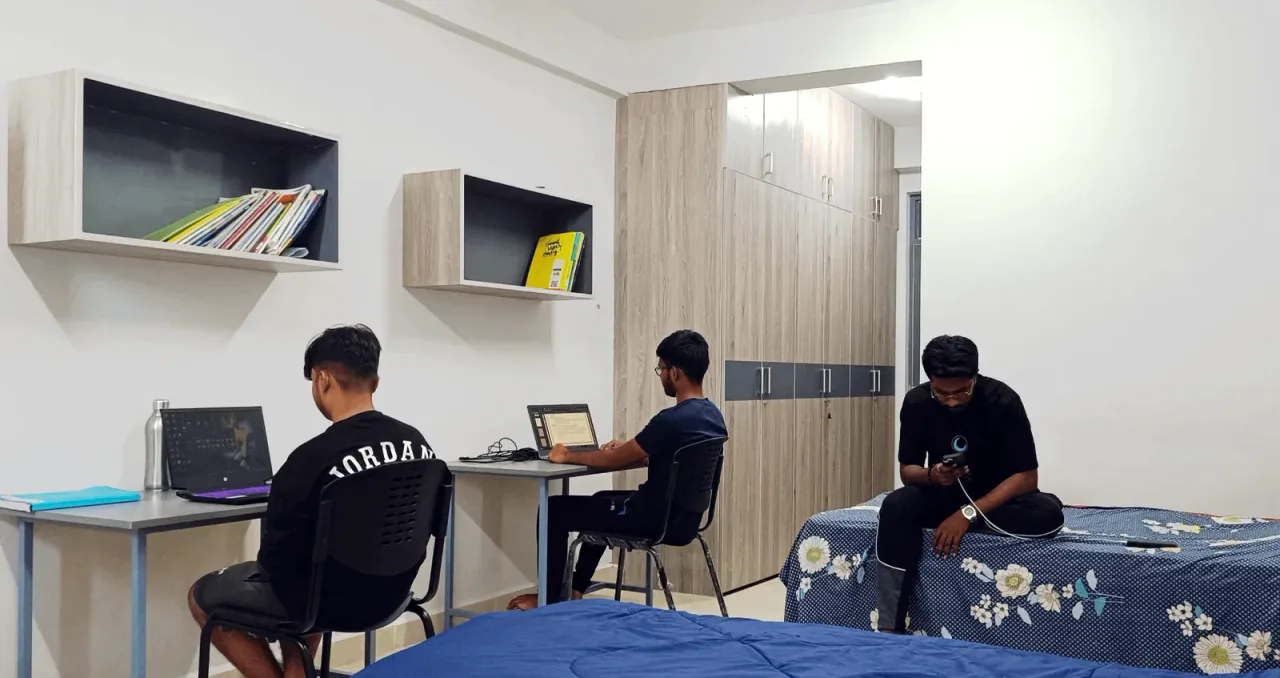
EPCET hostel details are listed in this section. capacity 566. hostel availability for boys and girls. amenities include Reading room; television room; internet; gymnasium; parking space; RO purified drinking water; laundry; 24x7 security; CCTV surveillance; anti-ragging vigilance; 24x7 ambulance facility; MoU with near-by multispecialty emergency hospital, Furnished rooms with attached bathroom; necessary amenities, furniture and accessories provided to each room, 24 hours Hot water and Electricity facility available.
566Capacity
boys + girlsGenders
Amenities
Reading room; television room; internet; gymnasium; parking space; RO purified drinking water; laundry; 24x7 security; CCTV surveillance; anti-ragging vigilance; 24x7 ambulance facility; MoU with near-by multispecialty emergency hospitalFurnished rooms with attached bathroom; necessary amenities, furniture and accessories provided to each room24 hours Hot water and Electricity facility available
Medical: 24x7 ambulance facility and MoU with a nearby multispecialty emergency hospital.
EPCET is a 15.9-acre engineering campus within the larger 99-acre East Point group campus, with 55 ICT-enabled classrooms, 4 seminar halls, a KOHA-enabled library, sports infrastructure, gym, cafeteria, and department laboratories.
AI-Powered Unified-Retail Hub for Hyper-Local, Personalized Shopping
Decentralized Cloud Storage Solution Using Blockchain for Data Security
MY-SR Next Gen Automated Gas Safety System Using IoT
Solar Panel Energy Generation Monitoring Device · App 425777-001
AI BASED SMART WATER PURIFIER · App 425134-001
MoU partners
InfosysCapgeminiQuantum LearningsAWS Academy (Amazon)CISCOOracleSalesforce - EthnusVMwareUniversity of NevadaInternational Universities (ECE collaborative)GTTC (Government Tool Room and Training Centre)Indian Green Building Council (IGBC)
Do not treat a later switch as guaranteed: read switching branch in 3rd semester. A move depends on the current VTU notice, your college's real vacancies and merit order.
See where it places in our transparent, fully-sourced ranking of every active Bangalore engineering college — scored on placements, NIRF, research, cutoffs and fees, with each figure linked to its source.
Is East Point College of Engineering (EPCET) an autonomous institution?
Yes. EPCET was granted autonomous status by AICTE and VTU effective from the 2024-25 academic year for an initial term of five years. All 2024-28 and subsequent BE batches follow a college-designed curriculum with continuous internal assessment, while degrees continue to be conferred by VTU Belagavi.
What is EPCET NAAC grade and validity?
The accreditation was issued in January 2025 and is valid till 01 January 2030.
Which programmes at EPCET are NBA-accredited?
Three undergraduate programmes at EPCET are NBA-accredited - Computer Science & Engineering (CSE), Electronics & Communication Engineering (ECE), and Information Science & Engineering (ISE).
What is EPCET KEA/COMEDK college code and VTU affiliation status?
The official EPCET brochure prints CET E096 and COMEDK E046, not a shared E097. The brochure contains historical material, so confirm the exact college and branch in the applicable current counselling matrix. The 2026 — 27 AICTE EoA identifies EPCET at Bidarahalli/Virgonagar, permanent ID 1-6231206, affiliated to VTU.
What are recent admission cutoff ranks at EPCET?
EPCET’s KCET college code is E096 and its COMEDK code is E046. In COMEDK 2025 Round 1, general-merit closing ranks were 44,561 for Electronics and Communication Engineering, 45,073 for Computer Science and Engineering, 61,605 for CSE (AI & ML), 67,436 for CSE (Data Science), 68,312 for Information Science and Engineering and 73,479 for CSE (IoT, Cyber Security and Blockchain). Later rounds can close at different ranks. For KCET, use KEA’s published cutoff list for E096 by round, category and branch.
EPCET’s mandatory disclosure lists a 2025 — 26 approved tuition fee of ₹1,21,610 for CET seats in its listed B.E. programmes, with other fees shown as nil, and ₹80,110 for each of its two M.Tech programmes. For 2026 — 27 COMEDK seats, COMEDK’s matrix lists EPCET (E046) B.E. courses at ₹2,35,000: tuition ₹2,15,000 plus other fee ₹20,000. Management-seat, hostel and mess charges are set by the college; get them in writing before paying.
No. EPCET engineering does not offer MBA or MCA. These are run by a separate institution within the East Point Group - East Point College of Higher Education (EPCHE). EPCET postgraduate programmes are limited to two M.Tech specialisations in Product Design & Manufacturing and Construction Technology.
What does EPCET’s NIRF 2026 filing report for the 2024 — 25 UG cohort?
EPCET’s NIRF 2026 Engineering submission reports 111 students placed among 373 minimum-time four-year UG graduates in 2024 — 25, a calculated 29.76%. The annual median salary among placed graduates is ₹5 lakh; 15 students are recorded separately as selected for higher studies. These are the submission’s four-year UG cohort figures, not a branch placement rate, branch average salary or individual highest offer.
How many research centres and industry MoUs does EPCET operate?
EPCET has six VTU-recognized research centres (Civil, CSE, ECE, Mechanical, Chemistry and Mathematics) supporting Ph.D. scholars, plus approximately 20 active industry MoUs. Partners include Salesforce, AWS Academy, VMware IT Academy, Cisco Networking Academy, Ui Path, Texas Instruments and ARM. An AICTE-supported IDEA Lab and an active IEDC/entrepreneurship cell operate on campus.
Where is EPCET located and how do I contact admissions?
East Point College of Engineering and Technology is located in Bengaluru, Karnataka.
Sources
Verification & sources
This page cites 191 source links. Each source is linked beside the facts it supports.
Last reviewed: 25 May 2026.
Reviewed by
Amrit Ashu
Lead Admission Counsellor. RV College of Engineering 2017 graduate, guiding students for admissions in Bangalore since 2017. Every figure on this page is checked against the official disclosures and sources linked beside it; admissions-office conversations are not used as citations.