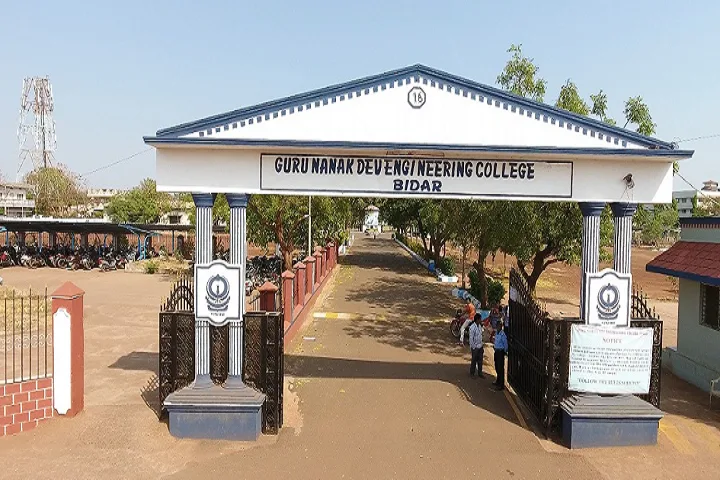
Guru Nanak Dev Engineering College — Fees, Management Quota, Cutoffs, Placements 2025
Guru Nanak Dev Engineering College (GNDEC) Bidar is a private VTU-affiliated engineering institution established in August 1980 by the Prabandhak Committee of Gurudwara Sri Nanak Jhira Saheb under…
₹4 lakh/year
Median salary · placed four-year UG graduates · 2024-25 · Source
Seat categories as published in the cited official source.
Branch
Annual fee
B.E. branches
Management seats (Category-3: management, NRI and other) · 2026–27
KEA’s 2026–27 engineering seat matrix lists GNDEC Bidar among private unaided minority engineering colleges and divides each B.E. course’s intake into Category-1 government (KEA) seats, Category-2 COMEDK seats and Category-3 management, NRI and other seats. The seat matrix allocates seats and does not list fees. Ask the college for the written 2026–27 fee for your branch and seat category, and its payment schedule, before paying.
KEA / KCET · E043KEA’s 2026 engineering list identifies GNDEC Bidar as E043. Use the authority allotment for the selected branch and seat category.Source
College engineering applicationThe college’s engineering form includes a Sikh-minority declaration and religion-certificate requirement for applicants using that category.Source
Second-year lateral entryThe engineering application distinguishes first-year admission from second-year lateral entry. Follow the programme-specific allotment and reporting instructions.Source
2KEA’s 2026 engineering list identifies GNDEC Bidar as E043. Use the authority allotment for the selected branch and seat category. The college’s engineering form includes a Sikh-minority declaration and religion-certificate requirement for applicants using that category. The engineering application distinguishes first-year admission from second-year lateral entry. Follow the programme-specific allotment and reporting instructions.
3Verify branch availability, official receipt format and refund policy before payment. Payment should go to the institution account.
4Pay only institution-confirmed tuition plus any documented college-level charges through the official payment channel. Hostel + transport billed separately; original documents deposited at admission.
Payment note: All published rates cover tuition only. Confirm branch-specific payment rules, receipt format, and refund terms with a College AndFees counsellor on Whats App.
Get current 2025-26 tier rates and branch-wise availability checks via WhatsApp.CollegeAndFees counsellor: +919844736561
GNDEC's fee for 2025-26 has not yet been verified from an official source. We only print fee figures we can cite from official documents — never estimates — so no amount is shown here.
GNDEC fee figures in the rows below have not yet been verified from an official source; no amount is inferred from unpriced quota or seat-status rows.Source: cetonline.karnataka.gov.in · pdf
Management quota · 2026-27 · fee by branch
Branch
Fee
B.E. branches
Management seats (Category-3: management, NRI and other) · 2026–27
KEA’s 2026–27 engineering seat matrix lists GNDEC Bidar among private unaided minority engineering colleges and divides each B.E. course’s intake into Category-1 government (KEA) seats, Category-2 COMEDK seats and Category-3 management, NRI and other seats. The seat matrix allocates seats and does not list fees. Ask the college for the written 2026–27 fee for your branch and seat category, and its payment schedule, before paying.
Fees for government (KCET) seats. KEA publishes separate Type-1 and Type-2 amounts for private unaided colleges, including minority colleges; the row that applies depends on the college’s fee type and the candidate’s category. KEA’s amounts include the university fee (₹12,320) and other fees (₹20,000).
Fee schedule
Academic year
Candidate category
Amount (INR)
KEA: Type-1 private unaided colleges
2026–27
General merit (GM, 2A, 2B, 3A, 3B; SC/ST with family income above ₹10 lakh; Category-1 above ₹2.5 lakh)
1,20,320
KEA: Type-1 private unaided colleges
2026–27
Category-1, family income up to ₹2.5 lakh
96,170
KEA: Type-1 private unaided colleges
2026–27
SNQ (supernumerary quota)
32,320
KEA: Type-2 private unaided colleges
2026–27
General merit (GM, 2A, 2B, 3A, 3B; SC/ST with family income above ₹10 lakh; Category-1 above ₹2.5 lakh)
GNDEC Bidar’s NIRF 2026 Engineering submission reports 247 students placed among 386 minimum-time four-year UG graduates in 2024–25, with a ₹4 lakh median annual salary among placed graduates. The same row reports 73 students selected for higher studies separately.
Updated
Three completed engineering cohorts: NIRF 2026
These institution-submitted NIRF data describe the labelled graduating cohorts; they are not a guarantee of employment. The denominator is students graduating in the minimum stipulated time, not all admissions, all final-year enrolments, or only students who registered for placement. The percentage below is calculated as students placed divided by that graduating count, rounded to two decimals. Higher-study counts are shown separately and are not added to placements. Median salary describes the placed graduates; it is not the mean, highest offer, or monthly take-home pay.
On smaller screens, scroll the table sideways to see every column.
The denominator changes the apparent placement rate
For 2023-24, NIRF reports 302 graduates, 202 placed and 68 selected for higher studies. The placed/graduated rate is 66.89%. Dividing 202 by 302 minus 68 instead produces 86.32%, but that is a different, adjusted denominator, not the rate among all graduates. NIRF does not label that subtraction as an eligible-for-placement count.
For 2024–25, 247 placed students divided by 386 minimum-time graduates gives 63.99%. The same row lists 73 higher-study selections separately and a ₹4 lakh annual median among placed graduates. This is a four-year UG cohort result, not a branch median or an eligible-applicant placement rate.
Postgraduate rows are not undergraduate branch outcomes
The two-year PG aggregate in the Engineering submission is reported separately. It is not a CSE/ECE/IT branch table and should not be used to infer an MBA or MCA-specific placement percentage without a programme split.
On smaller screens, scroll the table sideways to see every column.
Postgraduate rows are not undergraduate branch outcomes
GNDEC Bidar’s NIRF 2026 Engineering submission reports 247 placed students among 386 minimum-time four-year UG graduates in 2024–25, a calculated 63.99%, and a ₹4 lakh median annual salary among placed graduates. In 2023–24, the corresponding figures were 202 placed among 302 graduates, 66.89%, and a ₹4 lakh median. These are graduation-year results; higher-study selections are recorded separately, and the median is neither an average nor a highest offer.
The college homepage labels 1,200-plus students placed as a five-year total, a different time span from one graduating class. Its Training & Placement Department describes industry-led training and campus recruitment. For branch-specific recruitment enquiries, contact placement@gndecb.ac.in or +91 6364925581 / +91 9900418224 and specify the graduation year, branch and type of opportunity.
The Training & Placement Cell describes industry-led training and recruitment preparation. Ask for your programme’s marks/backlog rules, the unique students placed rather than offers, and whether a reported event was a campus, pooled or off-campus drive. Request the graduating cohort, registered/eligible pool, internship/full-time split, joining status and domestic/international compensation components.
The contact shown on the placement page is placement@gndecb.ac.in, with +91 6364925581 and +91 9900418224. State that you are enquiring about GNDEC Bidar to avoid similarly named institutions. Training support and a recruiter visit are not employment guarantees.
GNDEC cutoffs 2024. GM ranks are listed branch-wise below. CSE AIML R3 GM closing rank is 18,000.
BranchR1 GMMockR3 GM
CSE AIML——18,000
CSE Cyber——18,000
AI&ML——18,000
CSE DS——18,000
ISE——18,000
GNDEC admissions guide
GNDEC Bidar is listed by KEA under engineering code E043. Its engineering application covers first-year and second-year lateral entry and includes a Sikh-minority declaration with religion-certificate requirements. Use the applicable authority allotment and the college’s official enquiry process for the selected branch and academic year.
Updated
Identify the Bidar institution
Guru Nanak Dev Engineering College is at Mailoor Road, Bidar 585403, Karnataka. Its current site describes an autonomous institution affiliated to VTU and approved by AICTE. It is not Guru Nanak Dev Engineering College in Ludhiana; Punjab admission rules, recruiters and placement numbers must not be used for this campus.
On smaller screens, scroll the table sideways to see every column.
KEA’s 2026 list identifies GNDEC Bidar under E043, supporting the KCET/KEA route. The college has an official first-year/second-year lateral-entry engineering form and a current admission-enquiry page. The printed form also includes a Sikh-minority declaration and religion-certificate requirement for that category.
Apply through the authority responsible for the seat category. GNDEC’s official enquiry form collects the intended programme and school or diploma results; the engineering form distinguishes first-year admission and second-year lateral entry. Retain the authority allotment and the college’s reporting instructions with your application.
The engineering form includes a Sikh-minority declaration and asks Sikh applicants for a religion certificate. Complete only the declarations applicable to your category and use the category stated in the governing allotment or admission notice.
Academic eligibility and programme availability: obtain the current written rule
GNDEC’s enquiry form asks for 12th/PUC or diploma percentage. Its engineering application records subject marks and whether English was passed. Prepare these academic records with the entrance and allotment documents for the selected route, and obtain the college’s programme-specific reporting instructions before payment.
GNDEC’s academic directory covers BE, MBA, MCA and M.Tech study. Select the exact programme and branch named in the applicable approval and seat-allotment documents; a department directory describes academic offerings rather than vacant seats.
For postgraduate reporting, keep the qualifying degree and semester marks, relevant entrance score and category documents together. Use the programme-specific instructions for MBA, MCA or the selected M.Tech specialisation; each programme has its own qualification and reporting requirements.
The downloadable form covers admission to first year and second year by lateral entry. It requests the completed form, 10+2 marks statement, matriculation/date-of-birth certificate, transfer/leaving certificate, migration certificate, and a religion certificate for Sikh applicants. It also asks for category proof if claiming SC/ST/OBC and provides a diploma-marks section.
The form’s Karnataka-domicile wording and minority declarations are part of that form, not a replacement for the current KEA certificate-verification rules. Obtain an updated route-specific checklist, including originals, number of copy sets, photographs, allotment letter and payment receipt. For 371J/Kalyana-Karnataka eligibility, obtain the current authority’s accepted certificate and seat-category confirmation; living in a named district alone does not establish a universal reservation or fee entitlement.
Keep the exact Bidar institution/branch on every rank, application and allotment record.
Ask which signed declarations apply to your category; do not sign a Sikh-minority declaration for an unrelated route.
For lateral entry, confirm the current DCET route and qualifying diploma/degree requirements before using the second-year form.
Use GNDEC’s official enquiry page for programme enquiries and the admission authority’s current dated notice for allotment and reporting. State the academic year, branch and category, and obtain the final reporting date before travelling to the Mailoor Road campus.
Keep your admission-category documents and the written fee terms together. The college’s Sikh-minority declaration and KEA’s reservation or supernumerary categories have separate documentary purposes. See the college overview’s Fees section for the applicable published schedule.
College office: 08482-226949.
Email principal@gndecb.ac.in or principalgndecb@gmail.com, both published by the college.
For tuition and management-quota information, return to the GNDEC college overview. Confirm current costs with the institution.
Hostel · campus
GNDEC hostel
GNDEC hostel details are listed in this section. GNDEC Bidar operates fully residential — 95% of BTech students live on-campus across 4 hostel blocks (3 boys, 1 girls) accommodating ~1,400 students. AC twin-sharing INR.
GNDEC Bidar operates fully residential — 95% of BTech students live on-campus across 4 hostel blocks (3 boys, 1 girls) accommodating ~1,400 students. AC twin-sharing INR 85,000/year, non-AC INR 55,000-65,000, single AC (limited) INR 1.25 lakh/year. Mess INR 42,000-52,000/year (Karnataka authentic, North Indian, South Indian, Continental, Jain). Each room has cot, study desk, wardrobe, attached bathroom (newer blocks), 100 Mbps Wi-Fi. Common: gym, basketball court, cricket ground, table tennis, tuck shops, 24x7 medical room. Gurudwara on campus given Sikh trust.
Scholarships
Scholarships
GNDEC Bidar offers Merit Scholarship: top 1000 KCET ranks get 100% tuition waiver; ranks 1001-3000 get 50%; ranks 3001-7000 get 25%. The Guru Nanak Foundation Scholarship (named after Guru Nanak Dev) supports 30 students annually with 50-100% tuition waiver based on financial need + academic merit. Karnataka State Government Post-Matric Scholarship is available for SC/ST/OBC/MBC/EBC students. The 371-J scheme (Hyderabad-Karnataka quota — Bidar district benefit) provides additional support. Vidyasiri, AICTE Pragati (women), sports excellence (INR 25,000-50,000/year) all available.
GNDEC Bidar operates from a 50-acre campus in Bidar district, North Karnataka — 4 km from Bidar city central, adjacent to Bidar Air Force Station. The Engineering campus features 8 academic blocks housing CSE, ECE, IT, Mechanical, Civil, EEE, Production departments.
26 ac
Campus area
Campus facilities
Boys HostelGirls HostelWiFi CampusLibrarySports ComplexCafeteriaMedical CentreLabsPlacement CellGym
Research & rankings
Centres, patents, grants & MoU partners
GNDEC Bidar drives research across IoT, smart cities, AI/ML, sustainable energy, automotive engineering and structural engineering. The institute houses the Centre for IoT and Cyber-Physical Systems, the Centre for Sustainable Mobility (KPIT and Bosch collaboration) and the Centre for Cyber Security. Faculty publish 80-100 SCI/Scopus papers annually with research grants from DST, AICTE, MEITY, KSCST, plus North Karnataka state grants totaling INR 4-6 crore. The institute has filed 20+ patents.
Notable alumni
Distinguished graduates, rank holders & events
GNDEC Bidar engineering alumni network spans 18,000+ graduates since the institute opened in 1980. Notable alumni concentrate in IT services and manufacturing in Karnataka, Hyderabad, Bengaluru, Mumbai and the broader Sikh-engineering diaspora. The GNDEC Alumni Association operates chapters in Bidar, Hyderabad, Bengaluru, Mumbai, Pune, NCR, Singapore, Dubai, Bay Area, Toronto and London. Annual alumni meet "GNDEC Sangam" attracts 600+ alumni each January. The Alumni Mentorship Program connects 250+ student-alumni pairs annually.
When was Guru Nanak Dev Engineering College Bidar established and who founded it?
GNDEC Bidar was established in August 1980 under Karnataka Government Order ED 150 TEC 79 by the Prabandhak Committee of Gurudwara Sri Nanak Jhira Saheb, making it one of the oldest engineering colleges in the Kalyana-Karnataka region. The college is currently managed by the Sri Nanak Jhira Saheb Foundation, formally registered in March 1987 by the same Prabandhak Committee. The founder lineage traces to Sardar Joga Singh Ji, son of Sant Sardar Bhishan Singh and president of the Nanak Jhira Trust. The current Chairman is S. Balbir Singh with Reshma Kaur as Vice-Chairperson. Initially affiliated to Gulbarga University, it transitioned to VTU Belagavi from 1998-99 and has been granted autonomous status under VTU effective AY 2026-27.
What is the KCET college code for GNDEC Bidar and which admission routes are accepted?
GNDEC Bidar’s KEA engineering code is E043. Its engineering application distinguishes first-year entry from second-year lateral entry and includes a Sikh-minority declaration with a religion-certificate requirement for applicants in that category. Use the applicable authority allotment and college reporting instructions for the chosen branch and year. Diploma lateral entry follows the separate KEA/DCET qualification and branch-mapping process. Kalyana-Karnataka eligibility depends on KEA’s prescribed clause and certificate evidence; a Sikh-minority declaration serves a different admission category.
What B.E. branches and intakes are offered at GNDEC Bidar for AY 2025-26?
GNDEC’s institutional intake table for 2025 — 26 lists ten B.E. programmes: Computer Science and Engineering — 180; Electronics and Communication Engineering — 120; and 60 each in Artificial Intelligence and Machine Learning, Information Science and Engineering, Electrical and Electronics Engineering, Civil Engineering, Mechanical Engineering, CSE (Data Science), CSE (IoT and Cyber Security including Blockchain Technology), and CSE (Artificial Intelligence and Machine Learning). Its postgraduate table lists M.Tech CSE and M.Tech Digital Communication and Networking at 18 each, MBA at 60 and MCA at 60. In its announcement of 29 May 2025, the college reported NBA accreditation for Civil, CSE, EEE and ECE for 2025 — 26 through 2027 — 28, up to 30 June 2028. These intake figures describe the institution’s 2025 — 26 table, not current vacant seats.
What are the fees at GNDEC Bidar for the 2025-26 batch across different quotas?
GNDEC Bidar is listed in KEA’s 2026 — 27 seat matrix as a private unaided minority college. For 2026 — 27 government (KCET) seats, KEA’s schedule for private unaided colleges, including minority colleges, is ₹1,20,320 (Type-1) or ₹1,30,320 (Type-2) for general merit, ₹32,320 for SNQ (supernumerary quota) and nil for SC/ST candidates with family income up to ₹10 lakh. In the 2025 — 26 KRLMPCA minority colleges’ second-round counselling, GNDEC was listed under Religious Minority, with ₹2,00,000 collected by the college. Management-seat, PG, hostel and mess charges are quoted by the college.
Which documents apply to a Kalyana-Karnataka or Sikh-minority claim at GNDEC Bidar?
For a Kalyana-Karnataka reservation claim in KEA counselling, use the UGCET 2026 eligibility clauses and the prescribed supporting certificates, and select GNDEC Bidar under engineering code E043. KEA verifies eligibility and allots the notified seat category. GNDEC’s engineering application separately asks Sikh-minority applicants for a religion certificate; that declaration serves a different admission category. Keep the category documents and the fee terms in your allotment or college offer together when reporting.
Who is the Principal of GNDEC Bidar for the 2025-26 academic year?
Dr. Veena S. Soraganvi is the Principal of Guru Nanak Dev Engineering College Bidar for AY 2025-26, confirmed across official institutional references, VTU records and college communications. She is supported by Chairman S. Balbir Singh, Vice-Chairperson Reshma Kaur, and Director Administration Col. Ravideep Singh on the governance side. Academic heads are appointed per department within the ten B.E. programmes plus M.Tech, MBA and MCA divisions, and as of 1 November 2026 the college’s official site describes GNDEC Bidar as an autonomous institution under VTU.
What are the placement statistics at GNDEC Bidar for recent batches?
GNDEC Bidar’s NIRF 2026 submission reports 247 of 386 UG graduates placed in 2024-25, with a Rs 4 lakh median annual salary. Its official website simultaneously carries 10-LPA and 12-LPA highest-package claims without a reconciled cohort.
What hostel and campus facilities are available at GNDEC Bidar?
GNDEC Bidar operates on a 26-acre campus at Mailoor Road, Bidar-585403, offering separate boys and girls hostels within or near the campus, a central auditorium, and specialised labs and workshops for each engineering department. The central and digital library houses 32,530+ volumes with 84 national and 12 foreign technical journals and VTU Consortium digital access. Additional facilities include optical-fiber Wi-Fi, the CAMU digital campus platform for academic workflow, sports grounds with gymnasium, and a cafeteria. Co-curricular life centres on the annual Technovision tech-cultural fest and the Nostalgia alumni meet (December 2025 edition at GNDEC Bhavan). The MoE Institution's Innovation Council rated AAA for 2024-25 supports start-up activity and innovation events alongside industry MoUs.
Sources
Verification & sources
Fee and admission figures are shown with their linked sources. Confirm any figure with the college before paying.
Last reviewed: 26 Apr 2026.
Reviewed by
Amrit Ashu
Lead Admission Counsellor. RV College of Engineering 2017 graduate, guiding students for admissions in Bangalore since 2017. Every figure on this page is checked against the official disclosures and sources linked beside it; admissions-office conversations are not used as citations.